

Your Marketing Dashboard Looks Smart. It’s Not.
How To Think With Numbers and Turn a Dashboard Into a Decision Engine
Everyone sees numbers.
Many use them every day.
A few understand what they mean.
Even fewer know how to question them.
That’s why most dashboards, while looking impressive, don’t actually say anything.

Get Digital Tips & Tricks Delivered to Your Inbox

I was in a team meeting last month when someone mentioned a customer segment performing “120 on the index.” The room went quiet. Finally, someone asked, “Is that good?” The fact that the question needed to be asked tells you something about how many in marketing use numbers.
I’m sure you’ve seen it. Metrics thrown around like self-evident truths. But understanding what numbers actually mean? That’s a different skill entirely. It’s the quantitative side of critical thinking. Thinking clearly about the numbers is what keeps your data honest.

Read Critical Thinking for Marketers for the qualitative half of this same equation.
Thinking with Marketing Math
Without data, you’re just another person with an opinion. ~ W. Edwards Deming
Here’s what marketing math isn’t: it’s not about spreadsheets, pivot tables, or statistical formulas you haven’t used since college.
It’s about understanding what the numbers mean and what they reveal about your business. Using numbers to support your thinking helps you make decisions that drive growth.
Marketing math is a leadership skill. It’s the ability to look at a number and know what question to ask next. Because numbers don’t tell you what to do, they tell you what’s happening. Your job is to figure out why it matters and what comes next.
When you grasp the seven core concepts below, you stop relying on vendors who hide behind complexity. You stop making decisions based on reports you don’t fully understand. And you stop wasting money just because ‘the dashboard said so.’
The Gap I Keep Seeing
Innumerate marketers are surprisingly common. While there are many knowledge gaps, one stands out to me.
Absolute numbers describe. Relative numbers explain. ~ James’ism
The Context Gap: Absolute vs. Relative Numbers
Most marketing teams struggle with common metrics, not because they’re unintelligent, but because no one ever explained them properly.
What does “percent change” really measure? What’s an Index, and how do you interpret an index of 85 versus 115? What are they for?
Both measure relative change. They give absolute numbers context. They’re the basic tools you need to understand performance. But when your team can’t confidently explain them, decisions get made on gut feel instead of insight.
“We had 10,000 visitors last month.”
When someone reports 10,000 visitors, ask the only question that matters: compared to what? That one question turns numbers into insight.
Then you have, “We had 10,000 visitors last month. This is down 15% from October, and we’re on track to be 22% below our Q4 target.”
By including the percent change in the statement, you understand the number’s relative position, and the action that’s required is clear.
“We had 10,000 visitors” is the ‘what.’ “Traffic dropped 15% month-over-month” and “on track to be 22% below our Q4 target” are the context you need to understand ‘why’ the number matters. One tells you what happened. The other tells you whether to care.
Get comfortable asking, “Compared to what?” when you are presented with an absolute number.
The 7 Tools You Need to Turn Numbers into Strategy
You don’t need advanced math to think clearly about marketing math. Here are seven concepts that will help you interpret what you’re seeing.
1. Percent Change: Direction and Momentum
Percent change shows you speed and direction, not just volume.
If sales went from $100,000 to $110,000, that’s a 10% increase. If they went from $10,000 to $11,000, that’s also 10%. The dollar amounts differ, but the momentum is identical.
Percent change matters when comparing campaigns, channels, or time periods. Raw numbers can mislead you. Percent change keeps you honest.
2. Relative vs. Absolute Numbers: What’s the Real Story?
We covered this earlier, but it’s worth repeating: absolute numbers need context to have value.
“10,000 visitors” sounds impressive, until you learn it’s down 15% from last month. Or that it costs you $50 per visitor, a 15% increase over the previous month, to get there.
Always ask: compared to what? Relative to when? At what cost?
3. Indexes: Context at a Glance
An index compares one number to a baseline. The base is what’s expected. For example, if your monthly sales are generally $15K, you can use this as your base. An index of 120 means performance this month is 20% above average. An index of 85 means it’s 15% below. That’s it.
Instead of saying “Segment A spent $3,200 while the average was $2,500,” you can say “Segment A’s spending indexed at 128.” Indexes make pattern recognition fast and easy.
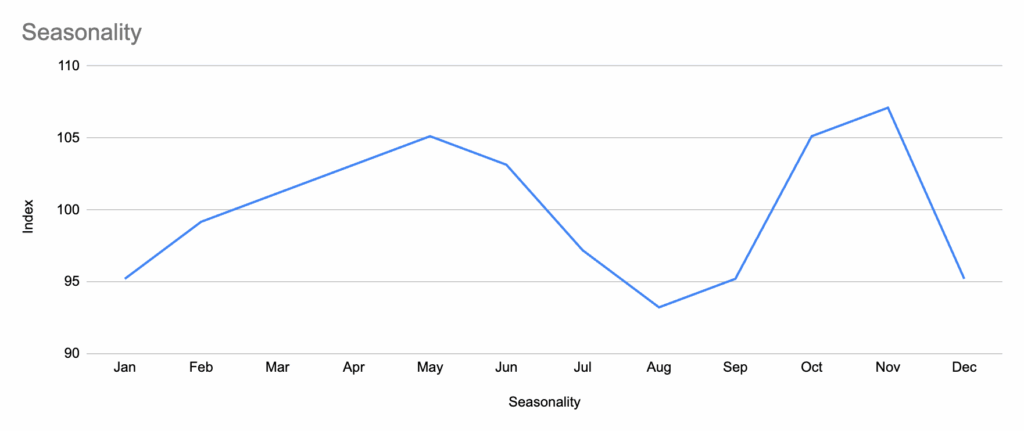
A common use case is showing seasonality. Index each month’s sales against the annual average. A line chart like the one below reveals seasonal patterns at a glance, so you don’t overreact to August’s dip.
4. Quintiles: Data Segmentation
Quintiles segments a customer base into five equal groups based on a criterion. This is usually a value score.
For example, RFM analysis gives each customer a score based on recency, frequency, and monetary value. This is nice but not useful. If you use quintiles to segment your customers by RFM score, you end up with five groups of equal size that you can understand and market to… or not.
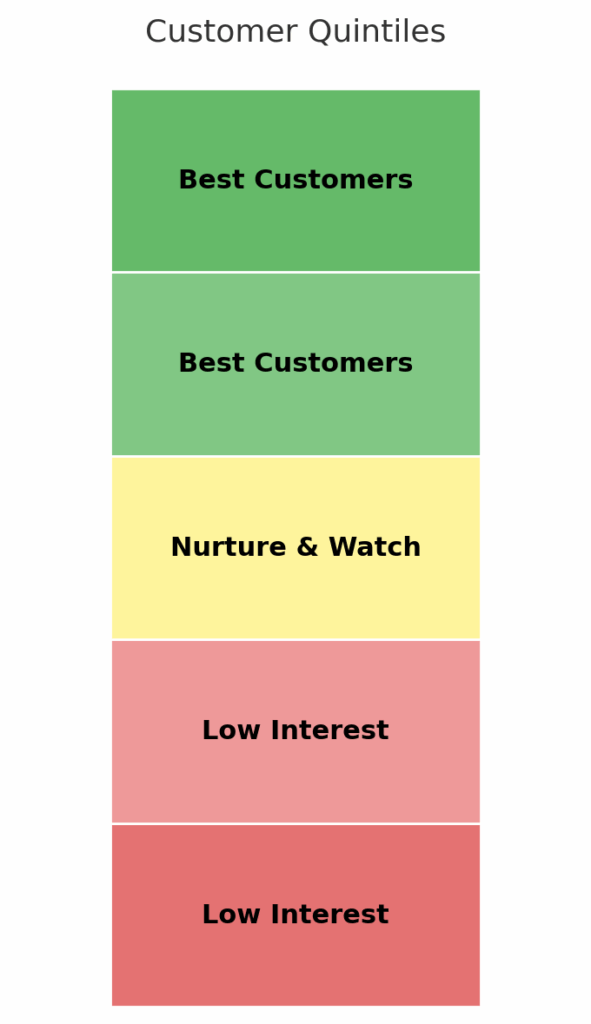
The top two quintiles? They’re your best customers. Your marketing ROI from this segment will be positive.
The middle quintile can be nurtured, but watch for signals. If they engage with an email by clicking a link, have a plan in place to support their interest.
The bottom two quintiles are the folks who have lapsed or never really needed what you are selling. You’ll never see a positive return from these segments.
Quintile analysis helps you focus your marketing on the segments that matter—the ones where a positive ROI is likely.
5. Confidence, Sample Size, and Correlation: Knowing When to Trust the Data
I bundled three related ideas together:
Confidence (statistical significance) tells you whether a result is real or just noise. If a test shows a 5% improvement but it’s not statistically significant, you can’t trust it yet.
Sample Size determines whether you have enough data to matter. Your new ad doubled clicks—great. But if only 20 people saw it, that’s not proof. That’s luck.
Correlation vs. causation; just because two things happen together doesn’t mean one caused the other. Ice cream sales and drownings both spike in summer. Ice cream doesn’t cause drowning. Warm days cause both.
The takeaway? Don’t celebrate small wins on tiny sample sizes. And don’t assume one thing caused another without testing the relationship.
6. Mean and Median: The Truth About “Average”
The mean is what’s commonly called the average: add everything up, divide by the count.
The median is the middle value when you line everything up.
Why does this matter? Because means can lie.
If nine customers spend $100 and one spends $10,000, the mean is $1,090. But that makes it sound like a typical customer spends over $1,000, which is wildly misleading. The median is $100, which actually reflects typical behavior.
When you’re analyzing customer sales data, the median often tells you more than the mean.
If you are presented with a mean (average), ask for the median. If they are similar, then you are probably good with the mean. If they are very different, then take a closer look at the source data. Means often hide insights.
7. Distribution and Standard Deviation: Understanding the Spread
Distribution shows you how your data is spread out. Are most customers clustered around similar behavior, or scattered all over the place?
Standard deviation measures the spread numerically. A low standard deviation indicates tight clustering and predictable, consistent results. A high standard deviation suggests wide variation in outcomes, with values all over the map.
Here’s why this matters: if your email campaigns generate click-through rates of 2% to 3% every month, you’ve got tight distribution and low deviation. That’s something you can count on. If they swing between 1% and 8%, your distribution is wide, making it less predictable. You can’t confidently forecast what happens next, and you should look at the data to understand why the deviation is high.
Understanding distribution also explains why the median often beats the mean. When you’ve got a few extreme outliers (like that one customer who spent $10,000), they skew the distribution, and suddenly your “average” doesn’t reflect typical behavior at all.
These seven concepts aren’t formulas to memorize. They’re the lenses you need to change how you see your data. Once you understand them, vanity metrics lose their shine, and those impressive-looking dashboards start delivering insights you can use.
From Tools to Thinking

Critical thinking protects you from bad logic. Marketing math protects you from bad data.
Don’t be a data puker. Be a data storyteller. ~ Avinash Kaushik
Together, they make your decisions more reliable.

For example, consider your car’s dashboard. You don’t need to understand how the engine works, but you absolutely need to know which lights matter and what they mean. When oil pressure drops, you pull over. When your engine temperature spikes, you don’t keep driving.
The same principle applies to marketing metrics. The goal isn’t to memorize formulas. It’s to develop a mindset of curiosity and validation. When someone hands you a report, you should instinctively ask:
- Compared to what?
- Is this change statistically significant?
- What’s driving this?
- Does this pattern hold over time?
Those questions don’t require a math degree. They require clear thinking and a refusal to accept numbers at face value.
Pretty Dashboards, Empty Insights

You just learned about seven marketing math concepts that most marketers never fully grasp.
I’ve seen it. Most marketing teams operate on instinct and vendor recommendations because no one ever taught them how to think with numbers. The numbers are flying around because they’ve been told that numbers are important.
Most dashboards look impressive because they’re full of vanity metrics that are beautifully presented, but useless for decisions. What’s usually missing? Context. The relative numbers that actually explain what’s happening.
Now you understand what they mean. And you know how to question them. Now you’ve got the tools to ask better questions, spot weak data, and make confident decisions.
Understanding marketing math and applying it are two different challenges. You can know these concepts cold and still struggle if your dashboard buries signal in noise, shows absolute numbers without context, or serves up vanity metrics instead of business drivers.
Dashboards should clarify, not decorate data. ~ James’ism
That’s where we come in. We build dashboards differently. Our dashboards are anchored in context, relative measures, and metrics that help you make better decisions rather than just display data.
If you’re tired of pretty reports that don’t actually help you run your business, schedule a consultation. We’ll discuss measurement systems built for clarity, not decoration.
Related Posts
-
Add Power Steering to Your Marketing
Learn how UTM codes turn hunches into confidence.
-
Marketing Math and Dashboards
Seven marketing math concepts that turn dashboards from decoration into growth decision engines.
-
The 6 Marketing Measurement Mistakes
The businesses that win will embrace marketing measurement to compound their wins. Six mistakes to avoid to be one of them.
Author: James Hipkin
Since 2010, James Hipkin has built his clients’ businesses with digital marketing. Today, James is passionate about websites and helping the rest of us understand online marketing. His customers value his jargon-free, common-sense approach. “James explains the ins and outs of digital marketing in ways that make sense.”
Use this link to book a meeting time with James.