

Don’t Cut. Think.
A Four-Phase Critical Thinking Decision System to Cut Waste, Not Growth
When revenue slows, the easiest move is to cut marketing. It feels decisive. It’s quick. It feels like the responsible thing to do, so it must be smart, right?
Not quite.
When I review marketing plans, I see the same pattern: cuts are made without due diligence. The result wasn’t efficiency; it was invisibility with their best customers.
Recessions don’t test your budget. They test your judgment. The companies that survive and emerge stronger aren’t the ones that cut fastest. They’re the ones who think clearest. And clear thinking follows a process, not a mood swing.
Critical Thinking is Armor

Get Digital Tips & Tricks Delivered to Your Inbox

The rising sea lifts all boats, even the leaky ones. But when the economy softens, you need a way to separate signal from noise. A simple decision loop—observe, clarify, weigh, act—cuts waste and keeps every dollar pointed at real demand.
Critical thinking in marketing isn’t about being smarter. It’s about structured curiosity that leads to better decision-making. It’s the ability to observe what’s actually happening, identify what matters, weigh options against evidence, and finally, act.
That’s your competitive advantage, your armor.
Your best customers are still buying. They need what you are selling. They’re just buying more carefully. If they’re thinking harder about every purchase, you should be thinking harder about every marketing dollar.
Critical thinking doesn’t eliminate risk. It mitigates waste. And in a recession, spending isn’t what drags you down. Waste is what kills you.

Critical Thinking in Marketing
Critical thinking in marketing is structured curiosity, which leads to disciplined reasoning under pressure. There are four acts: observe customer behavior closely, clarify what drives results objectively, assess options with evidence, not opinions, and act on conclusons while monitoring outcomes. This systematic approach transforms instinct into strategy and strategy into results.
Why Critical Thinking Is a Growth Skill
Critical thinking sounds academic. It’s not.
It’s structured curiosity. And if you’re in marketing, you already practice it instinctively every time you segment an audience, test a headline, or optimize a campaign.
The difference is whether you do it systematically or sporadically.
Critical thinking isn’t a soft skill. It’s a survival skill. In fact, it’s the number one ability employers say they can’t find enough of. It’s the skill that separates decision-makers from order-takers. In marketing, it’s what keeps strategy grounded when the noise gets loud.
At its core, critical thinking involves four acts:
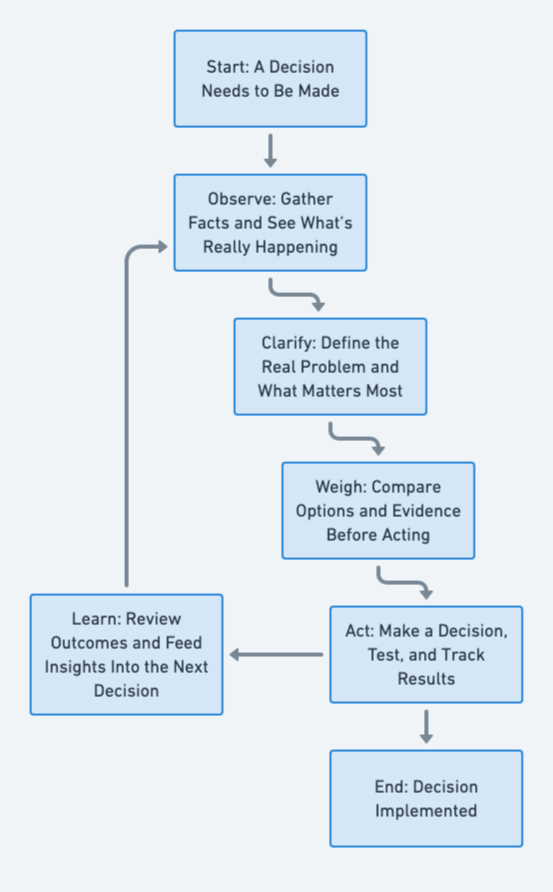
Observe
Look closely at what’s actually happening, not what you assume is happening. Pull the last 90 days of conversions by new vs. returning and first-touch vs. last-touch. You want to understand customer behavior, not admire campaign reports.
Clarify
Move past surface-level questions. Don’t just ask where the next dollar lifts results; ask what’s driving the lift and why.
Weigh
Draft a one-page decision memo with three options, your assumptions, and guardrail metrics.
Act
Make decisions that are supported by data and rooted in logic, and then monitor what happens next. For example, launch a 14-day test with a single success metric and pre-determined kill/scale criteria.
The problem isn’t that marketers lack critical thinking skills. It’s that we don’t apply them when pressure mounts and decisions need to be made fast.
Your customers are telling you what they need. Critical thinking helps you listen with discipline and act on what you’re told.
The Four-Phase Decision Loop
Most marketing frameworks tell you what to do. This one explains why decisions matter and how to make them hold up under pressure.
1) Plan Smart (Question Assumptions)
Before you execute anything, challenge your assumptions. Are they solid?
Trends aren’t strategies. Competitors aren’t oracles. What got you here may not get you there.
Just because everyone’s doing it doesn’t mean it’s right for your business. Does the trend serve your customer’s actual needs? Does it align with your brand? Or are you chasing novelty? Are you there because everyone else is?
Going against a trend can also be a good decision. Consider what Madeline Cecilia Dunn, the founder and CEO of Sherpa Skin, a premium skincare brand, is doing. She is promoting her business on LinkedIn. “Wait. What did you say?” Every other premium skincare brand is on Instagram. So is Sherpa Skin. But the other brands aren’t active on LinkedIn. Do you know who is active on LinkedIn? Lots of professional women who have both the means and the need for a premium skincare product.
Cutting your content team might save $8,000 this month. But if content is the foundation of your mid-funnel marketing strategy and drives 60% of your leads, you’ve just traded short-term relief for long-term revenue loss.
The principle is simple: decisions rooted in fear rarely improve outcomes. Decisions rooted in strategy almost always do.
2) Execute Intelligently (Test Before Scale)
Opinions are cheap. Evidence is expensive. But evidence is what separates guesswork from growth.
Replace Opinions with Tests
Before you commit budget to a new campaign, test it. A/B test your landing pages. Run usability tests on your messaging. Compare performance across segments.
If you launch a campaign based on gut feeling and it fails, you’ve wasted money and learned nothing. But if you test first, even failure teaches you something valuable.
A hypothetical: You’re redesigning your homepage. Your designer loves a minimalist layout. Your sales team wants bold CTAs above the fold. Instead of arguing, you test both. When one version converts 18% better than the other, you have your answer. And no one’s ego is bruised.
Measure Behavior, Not Activity
Testing tells you what works. Measurement tells you why it works and where it came from.
Implement UTM parameters on every campaign link. Tag your email campaigns, social posts, paid ads, and content shares with source, medium, and campaign identifiers. This isn’t busywork. It’s the evidence you need to make data-driven decisions.
When you know exactly which email, which blog post, or which LinkedIn ad drove a conversion, you can allocate budget with precision. You stop guessing which channels “feel” effective and start knowing which channels are effective.
A client called to tell us he wanted to stop investing in LinkedIn and double down on YouTube. “LinkedIn is boring.” So we looked at the data. The tracking showed us that YouTube wasn’t performing nearly well enough to justify the budget already being expended on the channel. Meanwhile, LinkedIn was quietly generating results.
Balance Quantitative and Qualitative Insights
Numbers tell you what is happening. Conversations tell you why. You need both.
If your email open rates drop, the data tells you that there’s a problem. But conversations with customers reveal why there’s a problem: your subject lines sound like spam.
Data without context is noise. Context without data is opinion. Data with context is insight. You need both for growth. ~ James’ism
Critical thinking isn’t just about reading dashboards; it’s about interpreting them. Data gives you clues. Judgment turns those clues into confident decisions.
3) Measure What Matters (Evaluate Rigorously)
This is where many marketers stop too soon.
You run a campaign. It works. You scale it. Done, right?
Not yet.
Ask: “If this is true, what else should be true?” One positive result doesn’t prove a strategy works. It proves it worked once. You need consistency.
A hypothetical: Your new email sequence generates 40 conversions in January. Great. But February delivers only 12. Was January a fluke? Did seasonality play a role? Was there a promotional event that skewed results?
Avoid These Logic Traps:
“It worked for them, so it could work for us.” Possible doesn’t mean probable.
“Sales went up, so the new campaign must be working.” Maybe. Or maybe the market rebounded. Test it again.
“The model says it’ll scale.” Models assume stability — markets rarely cooperate.
Run Confirmation Tests
Don’t just launch the winning campaign. Execute a confirmation test that repeats the test criteria with a larger sample and see if the results hold. If the results hold with the larger sample and across multiple tests, you’ve validated a strategy. If they don’t, you’ve identified variables you hadn’t considered.
Confirmation testing prevents you from scaling a fluke. It ensures that what worked wasn’t just luck; it was a replicable strategy.
Validate Across Time and Context.
Strong strategies perform reliably under different conditions. Weak strategies perform well only under ideal conditions.
One data point is a curiosity. Three data points is a pattern. Five data points is a strategy. ~ James’ism
4) Learn in Public (Build Thinking Loops)
Most marketing teams report results. Few marketing teams learn from them.
There’s a difference.
Reporting tells you what happened. Learning means you can do it again.
Clarity in thought becomes clarity in communication. When your team can articulate why a campaign worked, or didn’t work, when they’ve learned from the wins and losses, your future campaigns start stronger.
Use the 10:10:10 Debrief to Replace “Reporting” with “Learning”
Schedule periodic debriefs. Document results. Create assumption checklists.
- Cadence: Bi-weekly.
- The 10:10:10 Agenda: 10 min outcomes, 10 min assumptions vs. reality, 10 min decisions.
- Owner: Marketing lead.
- Action: Decisions logged in a one-page memo.
Build evidence dashboards that track performance across channels, audiences, and time periods.
A hypothetical: Every quarter, your team reviews the last 90 days of campaigns. You identify which messaging resonated, which channels underperformed, and which audience segments converted best. Then you adjust. Over time, your campaigns get sharper because you’re not guessing; you’re learning faster.
Guessing is luck. Learning is leverage. ~ James’ism
Spot Decision Distorting Mental Shortcuts
Our brains are wired for speed, not accuracy.
When decisions need to be made, “Is that a lion in the bushes?” they need to be made quickly, so your mind is hard-wired to take shortcuts.
These shortcuts are called cognitive biases. They helped our ancestors survive. But in business, they can distort judgment.
The good news?
Once you learn to recognize them, the biases become easy to see, and your decision-making sharpens.
10-Minute Bias Check
Here’s a 10-minute bias check you can run before making a big marketing decision:
- Flip it. What if you’re wrong?
- Change the measure. Try a different success metric.
- Block the noise. Ignore competitors for a moment.
- Forget the spend. Would you fund it again today?
- Hide the names. Judge the idea, not who said it.
Confirmation Bias: Seeing What Supports Your POV
You believe Instagram is your best channel. Your friends comment on the posts they’ve seen. Dashboard engagement metrics confirm it. Meanwhile, your email campaigns consistently deliver higher ROI, and you dismiss those numbers as outliers.
That’s confirmation bias. You’re filtering evidence to support what you already believe.
The fix: Assign someone to argue the opposite view. Make it their job to find contradictory data. If your hypothesis holds up, great. If it doesn’t, you just saved yourself from a bad bet.
Most people learn nothing from experience, except confirmation of their prejudices. ~ Bertrand Russell
Anchoring Bias: Building on Outdated Benchmarks
Three years ago, your customer acquisition cost (CAC) was $47. You’ve used that number ever since to set budgets and forecast growth.
But retention has improved. Lifetime value is up. Your CAC benchmark is outdated, and it’s distorting every decision you make.
The fix: Reassess key metrics quarterly. Test alternative reference points. Don’t let old anchors sink new opportunities.
Bandwagon Bias: Following Blindly

Everyone’s pivoting to short-form video. Your competitors are all-in on TikTok. Your nephew says it’s a good idea. So you shift resources, too. But, does your audience use the platform?
Popularity doesn’t equal correctness.
The fix: Require data justification before adopting any trend. Define success metrics before committing budget. Your competitors may be misled by bandwagon bias. You don’t have to join them.
Loss Aversion Bias: Keeping Underperforming Campaigns
You’ve spent $12,000 on a Google Ads campaign that’s delivering mediocre results. You know it’s not working. But you keep it running because pausing feels like admitting failure.
That’s loss aversion bias. You’re clinging to a sunk cost instead of reallocating to something better.
The fix: Reframe reviews around future value and opportunity cost, not past investment. The question isn’t “How much have we spent?” It’s “Where will the next dollar deliver the most value?”
Authority Bias: Trusting “Experts” Over Evidence
Your agency recommends doubling down on paid search. The director is confident. The presentation is polished. But your data shows organic content drives better conversions.
You follow the expert anyway.
The fix: Use blind evaluations. Strip names and titles from strategy proposals. Let the data speak first, then reveal the source.
Arguments from authority carry little weight. Authorities have made mistakes in the past. They will do so again in the future. ~ Carl Sagan
These biases don’t make you a bad marketer. They make you human. But when you build checkpoints into your process: hypothesis testing, bias checklists, team debriefs, you replace reflex with reason.
You can’t control the economy or the landscape you operate in, but you can determine your strategy. Critical thinking helps you do this rationally.
The ROI of Clear Thinking
Let me be direct: critical thinking saves money.
When you think clearly, you stop chasing false positives. You stop funding campaigns that “feel right” but deliver weak results. You stop making decisions based on opinion, outdated benchmarks, or competitor panic.
When the economy turns, spending isn’t the problem; wasteful spending is, and critical thinking reduces waste.
Many studies look at spending during a downturn, and the evidence is overwhelming. For example, McGraw-Hill Research analyzed 600 companies from 1980 to 1985 and found that firms that maintained or increased advertising during the 1981 recession saw 275% sales growth over the next five years, compared to only 19% for the companies that cut spending.
More recently, analysis of brands during the 2008 recession showed that those investing in excess share of voice saw 4.5 times the annual market share growth compared to those who pulled back.
Critical thinking prevents knee-jerk reactions. It helps you identify which channels drive real value, which messages resonate with your best customers, and which tactics are worth scaling.
When you think better, you market better. And when you market better, you serve customers better. And when you serve your customers, they serve your business.
The quality of our thinking determines the quality of our results. ~ Edward de Bono
Don’t Cut. Think.

Recession pressures are real. But reactionary cuts rarely pay off.
Marketers have never had more data, tools, or tactics. Yet most campaigns still underperform. The problem isn’t information. It’s interpretation. We’re taught what to think about, not how to think about it.
Critical thinking bridges the gap. Critical thinking helps you see options others miss. It turns uncertainty into opportunity. And when you balance logic and empathy, customers notice, trust is created, and they stay in the face of their own economic pressures.
The framework is simple:
- Question assumptions before you plan.
- Use data, not drama, when you execute.
- Evaluate rigorously before you scale.
- Learn and adjust after every campaign.
That’s it. Four phases. One principle: think first, act second. Because when you think first, you reduce waste, and every dollar you spend works harder.
If you’d like to see how a thinking framework can sharpen your next marketing decision, visit VIPChatWithJames.com. Let’s map it together.
Related Posts
-
Why Your Marketing Isn’t Working
Discover how marketing momentum breaks the Sisyphean cycle and watch your business grow.
-
Why Marketing Breaks
The real problem marketers face isn’t too much activity; it’s too little connectivity.
Author: James Hipkin
Since 2010, James Hipkin has built his clients’ businesses with digital marketing. Today, James is passionate about websites and helping the rest of us understand online marketing. His customers value his jargon-free, common-sense approach. “James explains the ins and outs of digital marketing in ways that make sense.”
Use this link to book a meeting time with James.